How to Make Your First 100$ With AI Data Work

Field guide · AI data work

A real beginner's roadmap. Real platforms, real pay, zero scams — written by someone who actually does the work.

By Favour · 9 min read · ✓ Field-tested


Working from where you already are, that's the whole appeal.

If you have typed “make money online” into Google even once, you have already seen the ads. Train AI from your couch, $60 an hour, no experience needed.

Most of those ads are stretching the truth pretty hard. But the work behind them is real, and people get paid for it every single week. I am one of them.

This is the guide I wish someone had handed me when I started. No hype, no fake screenshots, no “passive income while you sleep.” Just the honest path from knowing nothing to seeing your first $100 land in your account.

Let me walk you through it.

The basics

What AI data work actually is

Every AI tool you have used — ChatGPT, Claude, the image generators, all of it — learned from humans. Somebody had to show the model what a good answer looks like, flag the bad ones, and clean up the data it trained on. More and more, that somebody is regular people working from home.

The tasks are simpler than they sound. You might read two AI answers and pick the better one. You might rate a response for accuracy, label what is happening in an image, or rewrite a clunky paragraph so it reads better. A lot of it leans on something you already have, like writing clearly or knowing a subject well.


A lot of the work is this simple: which answer is better, and why.

Here is what it is not. It is not coding, mostly. It is not a salaried job with a manager and benefits. And it is not get-rich-quick. Think of it as flexible piece work that pays decently when you are good at it and the work is flowing.

No hype

The honest money talk

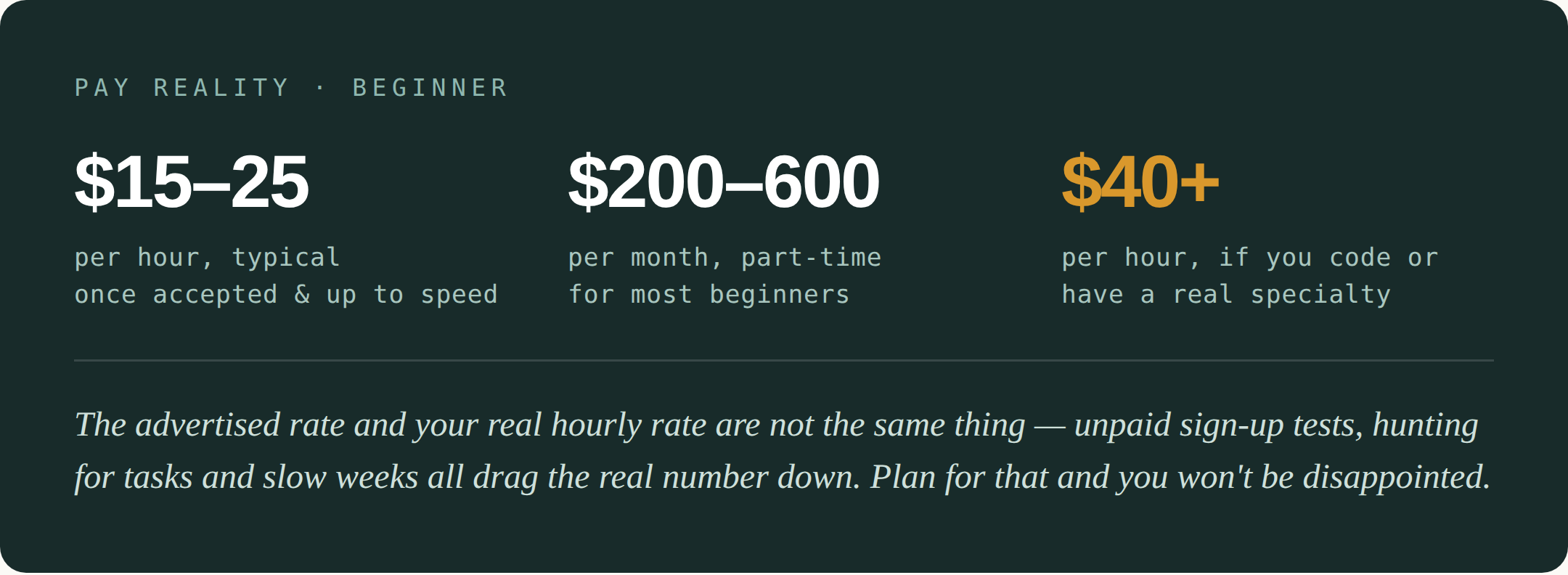
Let me kill the $60-an-hour fantasy before it costs you anything. That number is real, but it is the ceiling, not the floor, and it is reserved for people with serious coding or specialist skills.

You do not need a specialty to start, and you do not need it to hit your first $100. You just need to walk in with clear eyes.

The signature check

The 60-second scam filter

This space is full of legit platforms, but it attracts predators too. Run any “opportunity” through this filter before you give it a single minute of your time.

VERIFICATION CARD

WALK AWAY IMMEDIATELY IF —

They ask you to pay a registration or training fee. Real platforms never charge you to work — money flows to you.

The whole "interview" happens over WhatsApp or Telegram. Legitimate companies do not hire that way.

They pay only in points, crypto or gift cards, with no contract and no tax forms.

They want hundreds of unpaid test items before any paid work, with no clear standard for what passes.

GREEN-LIGHT CHECKS —

A real, verified profile shows up on LinkedIn and Glassdoor.

They pay in actual money through PayPal, Stripe, Wise or bank transfer.

If a platform clears all of this, you are probably safe to apply.

Step 01

Pick the right platform for where you live

This is the step most beginners get wrong, and it is the single biggest reason qualified people get rejected: they apply to a platform that does not even operate in their country. Before anything else, check the supported-countries list. Two minutes of checking saves you days of wasted effort.

Check eligibility first — it's the rejection most people never see coming.

A few solid starting points: DataAnnotation for strong writers (the application is a writing test), Outlier for variety and subject-knowledge tasks, Prolific for quick UK/EU research studies, and microtask sites like Toloka or Clickworker if you just want to test the waters. Don’t bet everything on one — pick two or three that fit you and apply to all of them.

Step 02

Pass the qualification test

Almost every real platform makes you pass a qualification test before you can earn a cent. This is the actual gate, and it is where most people quietly give up. The test is usually not hard — it is mostly checking whether you can read carefully and follow instructions exactly.

Set aside a quiet hour and treat it like it matters. Read the instructions twice before you touch anything. Match your application to the work. And know this: if you fail, a lot of platforms make you wait 30 days to retry — a good reason to slow down and get it right the first time.

Step 03

Expect the queue to go quiet

Once you are in, you will have great days with plenty of work, and then days where you log in and the queue is empty. This is normal — it is how the whole industry runs. Projects start and stop based on what the AI companies need that week.

The fix is simple: never depend on one platform. When one goes quiet, you switch to another. The people who earn steadily aren’t the ones who found the one perfect platform — they are the ones who spread out so the work never fully stops.

Treat it like a rotation, not a single job.

Step 04

Get to your first $100

Now put it all together. Here is the realistic path from a standing start:

1

Pick two or three platforms that operate in your country and fit your skills.

2

Apply to all of them in the same week — don't wait to hear back before trying the next.

3

Pass at least one qualification test. Give it your full focus.

4

When one queue dries up, move to the next.

5

Start tasking the moment you're approved, and keep your quality high.

Check eligibility first — it's the rejection most people never see coming.

At a beginner rate, $100 is roughly five to seven hours of accepted work. Most people who get in and stay consistent clear that within their first couple of weeks of active tasking. The slow part is almost always the front end — the applying and the waiting — which is exactly why applying to several at once matters so much.

⚠ Don't forget the tax part

On almost all of these platforms you are an independent contractor, not an employee. That means nobody is taking taxes out for you. In the US that is a 1099 situation, and you generally owe self employment tax on top of regular income tax.

The simple rule: set aside 25 to 30 percent of everything you earn for taxes, and do not touch it. Rules vary by country, so check what applies where you live.

The takeaway

Where to go from here

That is the whole path. Pick the right platforms for where you live, clear the scam filter, pass one qualification test, keep your quality high, and spread your work across a few platforms so it never fully stops. Do that, and your first $100 is not a maybe — it is a matter of weeks.

The first payout is the part that makes this feel real. Once you have proven to yourself that the money is legit, the question stops being “is this a scam” and becomes “how do I earn more.” That is a much better question to have.

Free starter kit

The exact platforms I'd apply to first

Drop your email and I'll send the country-eligibility cheat sheet, my qualification-test checklist, and an honest heads-up whenever a platform changes its pay. No spam — just the stuff that saves you time.
you@email.com
One email to confirm. Unsubscribe anytime.