Field guide · AI data work
The Generalist AI Projects That Put Money in Your Pocket
No special skills needed. From someone who builds and grades these tasks.
By Favour8 min read✓ Insider view
Most people think AI work is locked behind a computer science degree. It is not. There is a whole category of it built for regular people with regular skills, and it is called generalist work.
I build and grade these tasks myself, so let me pull back the curtain on what they actually are, what they pay, and how to get on them.
Regular people, regular skills. That is the whole category.

In AI training work, projects split into two buckets: specialist and generalist. Specialist projects want a specific background. Coding, law, medicine, advanced math, a particular language. They pay the most, but you need the credential to get on them.
Generalist projects are the other bucket, and they are the ones you want as a beginner. The platform is not testing what you studied. It is testing whether you can read carefully, write clearly, use common sense, and follow instructions to the letter. That is it. One of the big platforms spells it out on its own generalist listing: all degrees and areas of study accepted.
The basics
What "generalist" actually means
Generalist projects sound mysterious until you realize they are built from the same handful of task types, over and over.
The work itself
The tasks you will actually be doing
TASK 01
Comparing two answers
Two AI responses, one question. You pick the better one based on the rulebook, not your personal favorite.
TASK 02
Rating and ranking
Score a single response, or rank several, on accuracy, helpfulness, and tone.
TASK 03
Writing prompts
You write the questions that get fed to the AI, often ones designed to trip it up.
TASK 04
Writing prompts
You write the questions that get fed to the AI, often ones designed to trip it up.
TASK 05
Fact checking
The AI cites a source. You click through and check whether the claim actually holds up.
TASK 06
Fact checking
The AI cites a source. You click through and check whether the claim actually holds up.
TASK 07
Trying to break the AI
Feed it tricky, conflicting instructions and see if it slips. Creative troublemaking, paid.
None of that needs a degree. It needs attention and a bit of stamina.
The insider bit
The one skill that decides whether you get paid
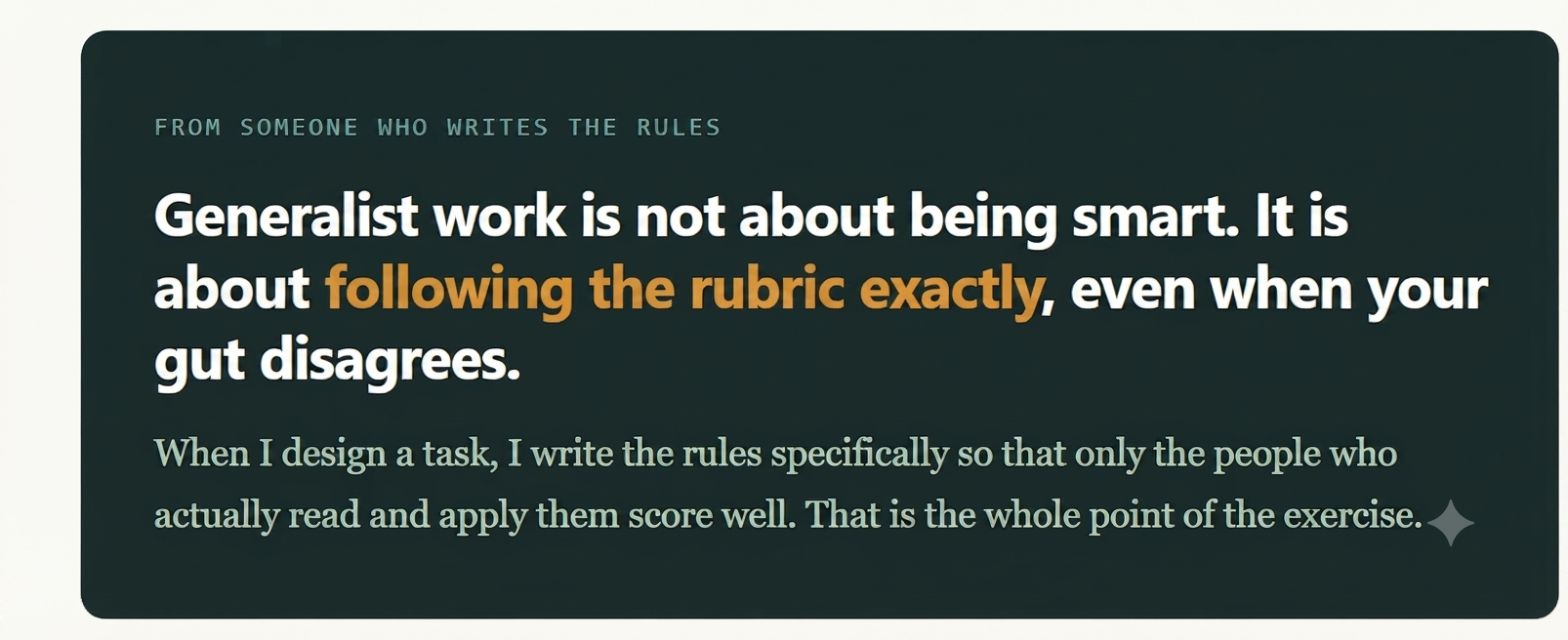
The people who get cut are almost always the ones who skim the rules and then go with their own opinion. "This answer is obviously better." Maybe it is, but if the rubric says to weight something else, your obvious answer is wrong and your scores tank.
So the move is simple but unglamorous: read the guidelines twice, keep them open while you work, and when your instinct fights the rubric, the rubric wins. Do that and you will outlast people who are smarter than you but lazier about the rules.
Free starter kit
I made you a rubric survival checklist
Where to apply
Where the generalist work lives
Not every platform is friendly to beginners, so aim at the right ones. A quick trick when browsing listings: look for tracks labeled "generalist," "writer," "language and writing," or "content review." Steer clear of anything labeled "developer" or a hard science, those reject a no-degree applicant on sight.
Solid starting points
DataAnnotation
~20+ USD/hr
Steady generalist and writing work. Asks for a degree or equivalent real world experience, so lead with whatever experience you have.
Handshake AI
22–30 USD/hr
An actual generalist track that accepts all fields of study. US only, needs work authorization.
Outlier
~15+ USD/hr
Plenty of generalist tracks, side by side and rating projects, more on the better projects.
Appen & TELUS Digital
lower, steadier
Lower paid generalist and language work. A decent stable base for when the bigger platforms go quiet.
The plan
How to actually land it
1
Apply to two or three platforms with generalist tracks, in the same week.
2
Pass the qualification test. This is where most people quietly drop out, so give it real focus and, you guessed it, follow the rubric.
3
Once you are in, keep your quality high. Accuracy is what keeps the better work flowing to you.
4
When one platform goes quiet, work another. Never lean on just one.
NO HYPE
What it actually pays
Generalist work usually lands somewhere around 15 to 30 USD an hour once you are accepted and working efficiently. Part time, that tends to be 200 to 400 USD a month. People who go hard, 30 plus hours a week across several platforms, can reach 1,500 to 3,000 USD, but that is a real grind, not a casual side thing. Two catches apply everywhere: onboarding for a new project often eats five to ten hours up front, sometimes unpaid, and the work comes in waves. Neither is a sign something is wrong. It is just how this industry runs.